In the heart of Johannesburg, a remarkable artistic movement is breathing new life into the discarded remnants of our digital age. South African artist Mbali Dhlamini has captivated the global art community with her groundbreaking series of sculptures crafted entirely from electronic waste, transforming obsolete motherboards, tangled wires, and shattered screens into profound commentaries on consumption, sustainability, and African technological sovereignty.
Dhlamini’s journey began not in a traditional studio, but in the sprawling e-waste dumpsites on the outskirts of Cape Town, where she witnessed first-hand the environmental and human cost of the world’s accelerating technological consumption. Moved by the juxtaposition of advanced technology lying useless amidst poverty, she began collecting these materials, seeing in their circuit boards and connectors not trash, but a new form of cultural tapestry. Her studio, a vibrant workshop filled with sorted piles of components, resembles an archive of technological history waiting to be reinterpreted.
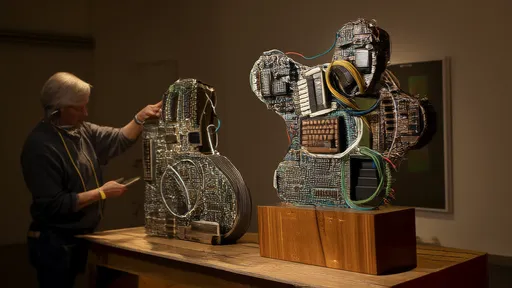
The sculptures themselves are breathtaking in their complexity and symbolism. One of her most acclaimed pieces, "Motherboard Matriarch," stands over eight feet tall, a regal female figure constructed from hundreds of layered circuit boards. Copper traces mimic the intricate patterns of traditional beadwork, while resistor arrays form eyes that seem to gaze knowingly at the viewer. The piece is both a tribute to the often-overlooked strength of women and a stark reminder of the literal groundwork—much of it mined in Africa—that underpins our global digital economy.
Another powerful work, "The Data Stream", is a sprawling installation resembling a river delta. Made from meticulously sorted cables of every colour—USB, Ethernet, power cords—it flows from a wall-mounted server rack, spreading across the gallery floor. The piece viscerally illustrates the physicality of our digital cloud, challenging the notion that data is weightless and clean. It forces the viewer to confront the tangible environmental footprint of every email sent and video streamed.
Dhlamini’s creative process is intensely physical and deliberate. She does not melt down or drastically alter the components; instead, she works like a collagist or a weaver, using their existing forms, colours, and textures. Components are carefully desoldered, cleaned, and sorted by colour and function. Wires are woven and braided. This method honours the original purpose of the materials while giving them a new, poetic narrative. She often says she is "not building something new, but revealing a story that was already there, buried within the silicon and copper."
The environmental message is unequivocal, but Dhlamini’s work transcends simple eco-activism. It delves into deeper socio-economic critiques. A significant portion of the world's e-waste is exported to developing nations, including those in Africa, often under dubious ethical and environmental guidelines. Her sculptures give physical form to this unequal exchange, questioning who bears the cost of technological progress and who is left to clean up the mess. She highlights the paradox of continents rich in the minerals needed for technology yet becoming the graveyard for its waste.
Furthermore, her art challenges the perception of African nations as mere consumers or dumping grounds for Western technology. By assembling complex, high-tech mosaics from this waste, she symbolically reclaims agency. She demonstrates innovation and mastery over the very materials that represent technological obsolescence and external imposition. It’s a powerful statement about self-determination and finding beauty and value in what the world has cast aside.
The reception to her series has been phenomenal. Exhibited from London to Tokyo, her work has sparked conversations in art circles, environmental conferences, and tech forums. Critics praise not only the aesthetic innovation and technical skill but also the potent narrative force. Her sculptures are described as "urgent and beautiful," and "a necessary mirror held up to our digital lifestyles." They serve as a catalyst, inspiring viewers to reconsider their own relationship with technology, consumption, and waste.
Looking ahead, Dhlamini is expanding her project to include community workshops, teaching young South Africans how to repurpose e-waste into art and functional objects. This initiative aims to foster environmental awareness and practical skills, turning a problem into a resource. She envisions a future where art not only comments on the world but actively participates in shaping a more sustainable and equitable one.
Mbali Dhlamini’s e-waste sculptures are more than just art; they are archaeological digs into our collective digital present. They are memorials to forgotten gadgets, critiques of global inequality, and hopeful blueprints for a circular economy. In the gleam of a soldered joint and the weave of a cable, she finds a powerful language to discuss our planet's future, proving that true innovation often lies not in creating something new, but in seeing the potential in what already exists.
By /Sep 11, 2025
By /Sep 11, 2025
By /Sep 11, 2025
By /Sep 11, 2025
By /Sep 11, 2025
By /Sep 11, 2025
By /Sep 11, 2025
By /Sep 11, 2025
By /Sep 11, 2025
By /Sep 11, 2025
By /Sep 11, 2025
By /Sep 11, 2025
By /Sep 11, 2025
By /Sep 11, 2025
By /Sep 11, 2025
By /Sep 11, 2025
By /Sep 11, 2025
By /Sep 11, 2025
By /Sep 11, 2025
By /Sep 11, 2025
