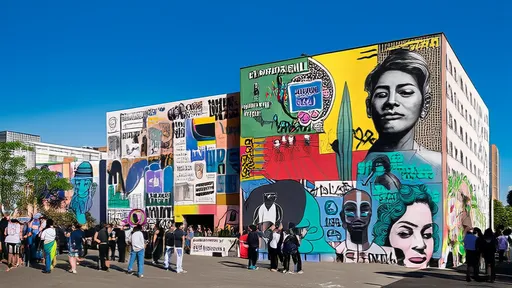
In the vibrant heart of São Paulo, where the hum of the city never sleeps, a transformation is unfolding on the walls that frame its streets. The annual Brazil Street Art Festival has returned, and this year, it carries a profound message woven into every brushstroke and spray can hiss. With social justice as its central theme, the festival has become more than an artistic showcase; it is a powerful, visual dialogue on equity, human rights, and the collective cry for change echoing across Brazil and beyond.
The festival, now in its tenth year, has always celebrated the raw, unfiltered energy of street art, but the 2024 edition marks a significant shift toward intentional activism. Curators and artists collaboratively chose social justice not as a vague inspiration but as a directive to challenge, educate, and inspire. The result is a sprawling open-air gallery that captures the complexities of modern societal struggles—from racial inequality and gender violence to environmental justice and indigenous rights.
Walking through the neighborhoods of Beco do Batman or the sprawling murals in Rio’s Santa Teresa, one is immediately struck by the scale and emotional depth of the works. A colossal mural by acclaimed artist Luna Silva depicts intertwined hands of different skin tones breaking chains, set against a backdrop of the Brazilian flag reinterpreted with shades of protest and hope. The piece, titled "Nosso Grito" (Our Cry), has already become a pilgrimage site for locals and visitors, serving as both a photo backdrop and a moment of reflection.
Another standout creation comes from Marcelo Costa, whose work often explores the favela experience. His mural portrays a child looking upward, surrounded by books and musical instruments, while shadows of inequality loom in the background. The image is poignant, layered with symbolism suggesting that education and art are pathways to liberation. Costa explained in an interview, "Art in public spaces belongs to everyone. It’s not locked in a museum. It breathes with the people, and in neighborhoods often ignored by policymakers, these walls speak truths that need to be heard."
But the festival is not solely the domain of established names. Emerging artists, collectives, and even community groups have claimed their space. In Salvador, a group of young Afro-Brazilian artists collaborated on a series of murals celebrating icons of Black resistance while critiquing systemic racism. Their work merges traditional Afro-Brazilian motifs with contemporary visual language, creating a dynamic narrative that honors the past while demanding progress.
Women artists, too, are at the forefront this year. Anita Morales, whose art fuses bold color palettes with themes of femininity and resilience, created a stunning piece in Recife that visualizes the strength of domestic workers—often underpaid and overlooked. Her mural shows a woman with a determined gaze, holding a broom in one hand and a book in the other, flowers sprouting from her hair. It’s a tribute to the invisible labor that sustains societies and a call for dignity and fair wages.
Indigenous voices, long marginalized in mainstream discourse, are also powerfully represented. A collaborative mural in Manaus, led by artists from Amazonian communities, illustrates the connection between land, culture, and survival. The artwork features faces painted with traditional patterns, surrounded by lush forest and endangered animals, juxtaposed with imagery of deforestation and industrialization. It’s a visceral reminder that social justice is inextricably linked to environmental justice.
Beyond the visual spectacle, the festival has sparked conversations through guided tours, workshops, and public panels. Scholars, activists, and artists gather to discuss how public art can influence policy and public perception. In a workshop titled "Art as Action," participants learn to use stencils, posters, and murals as tools for advocacy, blending technique with theory.
The response from the public has been overwhelmingly positive, though not without controversy. Some murals, particularly those critiquing political corruption or police brutality, have sparked debate. Yet even criticism is welcomed by organizers, who see it as part of the discourse that art provokes. "Social justice isn’t comfortable," noted festival director Carla Mendes. "It’s meant to unsettle, to ask hard questions. If our art doesn’t stir emotion—whether hope or anger—then we haven’t done our job."
As the sun sets over São Paulo, the murals take on a new life under the glow of streetlights and projectors. Night tours have become popular, offering a different perspective on the art and its messages. For many residents, these works are not temporary installations but lasting monuments to the struggles and dreams of their communities.
The Brazil Street Art Festival has always been a celebration of creativity, but this year, it has cemented its role as a platform for social change. Through the language of color and form, artists are translating abstract ideals into tangible calls to action. In a country grappling with deep-seated inequalities, these walls do more than decorate—they testify, resist, and imagine a more just world.
As the festival continues to draw international attention, it reinforces the idea that art, especially art that lives in the streets, remains one of the most democratic and potent tools for advocacy. In the words of a young participant from a local community center, "They see our pain, our power, and our hope on these walls. And now, they have to listen."
By /Sep 11, 2025
By /Sep 11, 2025
By /Sep 11, 2025
By /Sep 11, 2025
By /Sep 11, 2025
By /Sep 11, 2025
By /Sep 11, 2025
By /Sep 11, 2025
By /Sep 11, 2025
By /Sep 11, 2025
By /Sep 11, 2025
By /Sep 11, 2025
By /Sep 11, 2025
By /Sep 11, 2025
By /Sep 11, 2025
By /Sep 11, 2025
By /Sep 11, 2025
By /Sep 11, 2025
By /Sep 11, 2025

By /Sep 11, 2025