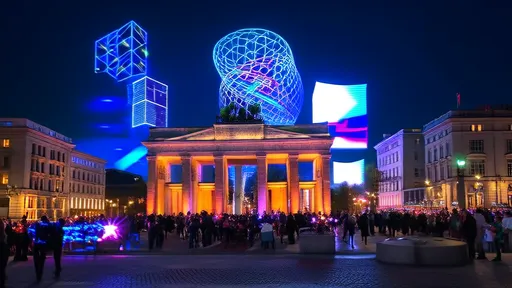
The Berlin Festival of Lights, an annual spectacle that transforms the city's iconic architecture into a canvas of illumination, has taken a revolutionary turn this year. For its latest edition, the festival has placed Artificial Intelligence at the very heart of its creative vision, orchestrating a symphony of light that is not just designed by humans, but co-created with machine intelligence. This bold pivot is more than a thematic choice; it is a profound statement on the future of art, technology, and their convergence in public spaces. The city's familiar skyline, from the Brandenburg Gate to the Berlin Television Tower, has been reimagined through the algorithmic lens of AI, offering a glimpse into a new era of creative expression.
The core of this year's festival lies in its groundbreaking use of generative AI to produce the visual narratives projected onto Berlin's monuments. Artists and technologists collaborated, feeding complex algorithms with vast datasets—historical archives of the city, classical art, architectural blueprints, and even real-time data streams of Berlin's heartbeat: traffic flow, social media trends, and weather patterns. The AI didn't merely execute pre-designed commands; it interpreted, learned, and generated unique visual sequences. The result is a dynamic, ever-evolving display where no two nights are exactly alike. The Brandenburg Gate might be draped in patterns that morph from Prussian-era motifs into abstract data visualizations of a modern, connected metropolis, all flowing seamlessly into one another.
This collaborative process redefines the role of the artist. Instead of being the sole author meticulously crafting every frame, the artist becomes a curator, a conductor guiding the immense potential of the AI. They set the parameters, the mood, the initial "seed" of inspiration, and then engage in a dialogue with the machine. The AI proposes, the artist refines; the artist suggests, the AI extrapolates. This iterative dance produces outcomes that are often surprising, pushing human creators beyond their inherent biases and stylistic habits. It unlocks a form of augmented creativity, where the artist's vision is amplified by the machine's ability to process and combine influences on a scale impossible for the human mind alone.
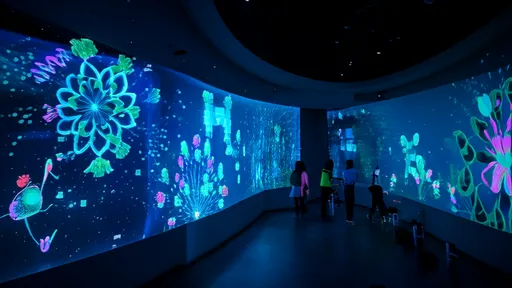
For the audience, the experience is transformative. The projections are no longer static light paintings but living, breathing entities. A projection on the Berlin Cathedral might subtly change its color palette in response to a shift in the evening's humidity, or the patterns animating the façade of the TV Tower could pulse rhythmically with live data from the city's transportation network. This creates a deeply immersive and responsive environment, making the audience feel connected to the artwork in a real-time, visceral way. The boundary between the artwork and the context in which it exists becomes beautifully blurred, turning the entire city into an interactive installation.
Inevitably, this AI-centric approach sparks crucial conversations about authorship, authenticity, and the soul of art. Can a piece of art generated by an algorithm carry the same emotional weight and intention as one born solely from human experience? The festival itself becomes a platform for this philosophical debate, lived out in the dazzling visuals on display. The works do not offer easy answers but instead invite viewers to ponder the nature of creativity itself. Is it a uniquely human trait, or can it be learned, replicated, and even enhanced by silicon and code? The light shows become a metaphor for this exploration—ephemeral, beautiful, and profoundly thought-provoking.
Beyond the philosophical, the festival serves as a massive, open-air laboratory for the practical applications of AI in large-scale event production and urban design. The logistical complexity of mapping intricate, AI-generated visuals onto uneven, historical surfaces is a feat of engineering and software development. The techniques and technologies refined here have implications far beyond the art world. They could influence how we design smart city interfaces, create public information displays, or even how we preserve and reinterpret historical sites through dynamic digital augmentation. The festival demonstrates that AI's role in our future urban landscape can be not just functional, but deeply cultural and aesthetic.
As the lights fade on this year's Berlin Festival of Lights, the impact of its AI-generated core will undoubtedly linger. It has successfully demonstrated that artificial intelligence, when guided by human curiosity and artistic intent, can be a powerful partner in creation rather than a mere tool. It has challenged preconceived notions of art and technology as separate domains, weaving them together into a spectacular public experience. The festival has not just illuminated Berlin's buildings; it has shone a light on a promising and collaborative path forward, where human and machine intelligence combine to create new forms of beauty, wonder, and meaning for everyone to share.
By /Sep 11, 2025
By /Sep 11, 2025
By /Sep 11, 2025
By /Sep 11, 2025
By /Sep 11, 2025
By /Sep 11, 2025
By /Sep 11, 2025
By /Sep 11, 2025
By /Sep 11, 2025

By /Sep 11, 2025
By /Sep 11, 2025
By /Sep 11, 2025
By /Sep 11, 2025
By /Sep 11, 2025
By /Sep 11, 2025
By /Sep 11, 2025
By /Sep 11, 2025
By /Sep 11, 2025
By /Sep 11, 2025
By /Sep 11, 2025
